Showing posts with label French film. Show all posts

Tuesday, January 11, 2011

Reel Rewind: “Mademoiselle Chambon”


Sounds within the silence. Stirrings within the stillness. Wonderings within the winds. The story of Jean and Véronique unfolds slowly in “Mademoiselle Chambon” with the accompaniment of Franz Von Vecsey’s composition “La Valse Triste” and Edward Elgar’s violin and piano piece, “Salut D’amour”. Their story is one of romantic feelings born with music, a touch and kisses. In films (and I suppose as in life), most beginnings of romance demonstrate some level of passion between the people involved. It is rare to see such quietness in a new romance and it is presented to great effect in the film - Véronique sitting still in her apartment and Jean at his kitchen table at 3:00 a.m. There is no outward intensity when they are together and I don’t feel that passion is happening beneath the surface, though that may have been the director’s intent. It seems that neither one knows where to go with whatever feelings they have.

The one tangible evidence that there are feelings is the note Jean slips under Véronique’s door in which he writes - “Je pense à vous”, (“I think of you”). In addition, the music creates a soothing atmosphere – nothing that would evoke the manifestation of emotions, just reflection in the silent scenes, of which there are many. Even the eventual lovemaking is quiet. Only Jean’s one-sided argument with his wife Anne-Marie over his father’s eightieth birthday party and his fight with a co-worker mar the idyllic atmosphere of “Mademoiselle Chambon”. The music of the film is what binds these two different people. Jean is a builder with a wife, son and simple life in Provence, while Véronique is a teacher whose home is Paris and apparently has a less-than-fulfilling family life. One wonders if Véronique was going to be a concert violinist and what happened to turn her towards teaching.

The slow pace of “Mademoiselle Chambon” does contribute to the overall ambience being projected of life in the countryside, but it is too slow and the non-Jean and non-Véronique short scenes without dialogue really don’t add anything to the viewer’s understanding or help move the story along. Jean and Véronique are nice people and the start of their romance is sweet, but the viewer (at least this one) becomes impatient for the development of the relationship. And not until the end of the film is the resolution revealed. It is ironic that the title of the film is “Mademoiselle Chambon”, as she is the lesser known of the two main characters and questions remain regarding her history. Perhaps more is presented in the novel. The film seems to be Jean’s story. As much as the music and movie mesh together, it is fitting that the song, “Quel Joli Temps (Septembre)”, closes out the film over the end credits. Anyway, if you do see this film, be sure to be well-rested and fully awake. For me, “Mademoiselle Chambon” is un peu sucré et un peu triste (a little sweet and a little sad).


Film Facts: Director/Writer: Stéphane Brizé, Writer: Florence Vignon, Novelist: Eric Holder, Cinematographer: Antoine Héberlé, Editor: Anne Klotz, Musician: Ange Ghinozzi, Producers: Jean-Louis Livi, Amélie Melkonian, Milena Poyloi, Gilles Sacuto, Production Companies: TS Productions, F Comme Film, arte France Cinéma, Canal+, TPS Star, Centre National de la Cinématographie (CNC), Rézo Films, Sofica Soficinéma 4, Région Provence Côte d’Azur, Procirep, Angoa-Agicoa, Porgramme MEDIA de la Communauté Européenne

Film Type: Drama, Romance, Cast: Vincent Lindon (Jean), Sandrine Kiberlain (Véronique Chambon), Aure Atika (Anne-Marie), Jean-Marc Thibault (Le père de Jean), Arthur Le Houérou (Jérémy), Bruno Lochet (Collégue de Jean 1), Abdellah Moundy (Collégue de Jean 2), Michelle Goddet (La directrice de l’école), Anne Houdy (La commerciale des pompes funèbres), Geneviève Mnich (La mere de Véronique), Florence Hautier (Soeur de Jean 1), Jocelyne Monier (Soeur de Jean 2), Jean-François Malet (Le beau-frère), Maxence Lavergne (Elève classe de Jérémy), Philomène Pagnier (Elève classe de Jérémy), Length: 101’, Language: French, Country: France, Year: 2009
Official Website
France release date Wednesday 14 October 2009
United States release date Friday 28 May 2010
Film Trailer


Images:
Left: Sandrine Kiberlain (Véronique Chambon) and Vincent Lindon (Jean) from the website thecia.com.au
Center: Graphic interpretation of “Mademoiselle Chambon” created by Adrean Darce Brent
Right: “Mademoiselle Chambon” poster from the website critic.de
Below: "Reel Rewind" logo created by Adrean Darce Brent


Wednesday, November 3, 2010

Reel Rewind: “Un Balcon Sur La Mer”


French title – “Un Balcon Sur La Mer” / English language title – “A View Of Love”
The translation of the French title into English would be “A Balcony Overlooking The Sea” and the English language title would be “En Vue De L’amour” in French. After seeing the film, my choice for the French title would be “En Vue De L’amour”, with “A View Of Love” for the English language title.

Although my invitation to see the World Premiere of “Un Balcon Sur La Mer” is from the French Consulate of Los Angeles, the film is actually one of the screenings for the first day of the 2010 American Film Market. Of course I didn’t discover this until my arrival at the AMC Criterion theatre in Santa Monica. The AFM is an annual event in Santa Monica for industry buyers/players from around the globe. Since I am only tenuously connected to the film industry, I am pleased to attend the Market, even if I am not a potential buyer and it is just for one screening.

Well, this World Premiere is not getting off to a good start – some of the lights in the theatre are not turning off, but they go ahead and start the film. However, a few minutes into the showing of “Un Balcon Sur La Mer”, the film stops. All the lights come up and a man announces, in French and English, that they are going to start over again. This time all the lights turn off and the film is projected from the beginning without any further problems.

Real estate agent Marc enjoys working with his father-in-law and happily lives in Southern France with his wife and daughter. However, the past arrives one day, upsets his present and changes his future. The past is a girl named Cathy who Marc loved during his childhood in Algeria, before the country achieved independence. The return of Cathy into his life disrupts Marc’s domesticity and brings back memories of life in Oran before his family’s abrupt departure to escape the violence. Allowing himself to fulfill his childhood love for Cathy, Marc irrevocably changes the future for himself and his family. Perhaps it is the lack of closure in his youth that propels Marc towards this life changing behavior.

But all is not completely right. Although a number of memories of Algeria are recounted, some memories for Marc and Cathy are not shared/same ones and they should be. Has time diminished or distorted them? When Marc questions his mother about Algeria and his friend Cathy, she reveals some disturbing information that he can’t believe – won’t believe about this woman who has reentered his life. What is the truth and will Marc be able to see it through the love? Marc searches for answers and in so doing uncovers a real estate scam from inside the agency and Cathy’s role in the deception. He is able to prevent the completion of the scam and although Cathy’s complicity is undeniable, Marc chooses to be with her. She is a part of his life whose ending left a space in his heart and no matter what the reality, for Marc, now only she can give him back his first feelings of love for the girl Cathy.

Though the film does not go in the direction I thought it would (more straightforward, more anguish about his wife and daughter, rejection of the deception), “Un Balcon Sur La Mer” nevertheless provokes one’s thinking of the struggle for independence, aspects of life that still remain open, how perceptions can change, but maybe not so much. The films starts out in a calm morning in Algeria and ends in a rainy night in France and in between is the life of the boy Marc and the man Marc coming to a resolution for love. So I ask, what needs resolution in your life? Better still, what needs resolution in my life?


Film Facts: Director/Writer: Nicole Garcia, Writers: Frédéric Bélier-Garcia, Natalie Carter, Jacques Fieschi, Cinematographer: Jean-Marc Fabre, Producers: Xavier Amblard, Alain Attal, Gaëtan David, André Logie, Frantz Richard, Production Companies: Europa Corp, France 3 Cinéma, Les Productions des Trésor

Film Type: Drama, Romance, Thriller, Cast: Jean Dujardin (Marc), Marie-Josée Croze (Cathy), Claudia Cardinale (Marc’s Mother), Toni Servillo (Marc’s Colleague), Sandrine Kiberlain (Marc’s Wife), Michel Aumont (Marc’s Father-in-law), Jean-François Malet (Le gardien), Philippe Napias (Thierry), Length: 105’, Language: French, Country: France, Year: 2010
Film Trailer
France release date Wednesday 15 December 2010
No United States release date set as of this post


Images:
Left: Jean Dujardin as Marc from the website lyricis.fr
Center: Graphic interpretation of “Un Balcon Sur La Mer” created by Adrean Darce Brent
Right: “Un Balcon Sur La Mer” poster from the website cinemotions.com

Friday, April 23, 2010

Reel Rewind: “Gardiens De L’ordre”


French title – “Gardiens De L’ordre” / English title – “Sphinx”
This is not a direct translation of the French title into English, which would be “Guardians Of The Order”. I actually like the English title better – more in line with the film. Gardiens De L’ordre brings images of vigilantes, storm troopers, and knights templar to my mind. Sphinx actually is specific to the film, although Sphinx might bring to mind Egypt. In any case I would make “Le Sphinx” the French title and have “The Sphinx” be the English title.

It’s small. It’s round. It’s yellow. It glows in the dark. And it fires your brain into craziness. Sphinx is the newest platinum standard street drug that Julie and Simon need to find in order to dissolve the department cover up, which if it sticks, will cost them their police careers. They are on their own in pursuit of the drug suppliers and go undercover as drug dealers while performing desk duty at the police station. Still working at the police station gives them access to information and materials useful in catching the suppliers. Of course they are vindicated in the end and there were no real surprises in “Gardiens De L’ordre” – same situations seen in other films of this type.


Film Facts: Director: Nicolas Boukhrief, Writers: Dan Sasson, Nicolas Boukhrief, Cinematographer: Dominique Colin, Editor: Lydia Decobert, Musician: Nicolas Baby, Producer: Sylvie Pialat, Production Companies: Les Films du Worso, Gaumont, Entre Chien et Loup
Film Type: Crime/Thriller/Drama, Cast: Cécile De France (Julie), Fred Testot (Simon), Julien Boisselier (Marc), Nicolas Mane (le commissaire principal), Stéphan Wojtowicz (Gilbert), Nanou Garcia (Sandrine), Stéphane Jobert (Roland), Jean-Michel Noirey (Rudy), Gilles Gaston-Dreyfus (Christian), Foued Nassah (Joseph), Anthony Decadi (Stan), Length: 105’, Language: French, Country: France, Year: 2010.
Film trailer
No United States release date set as of this post.


Images:
Left: Front side of the ticket for “Gardiens De L’ordre” (“Sphinx”)
Center: Graphic interpretation of “Gardiens De L’ordre” created by Adrean Darce Brent

Right: Fred Testot as Simon and Cécile De France as Julie from the website ecranlarge.com

Reel Rewind: “Pierrot Le Fou”


French title – “Pierrot Le Fou” / English title – none
There is no actual English title of this French film to rate. I would go for the direct translation (of course!) and title it “Pierrot The Fool”. And a non-direct translation could be – “Ferdinand’s Folly”.

Here is my major French film confession – “Pierrot Le Fou” is only the second film by Jean-Luc Godard that I have seen. The other being “À Bout De Souffle” which translate as “At The End Of Breath”, but its actual English title is “Breathless”. Though they both deal with being on the run, the structures of the two films are different – “A Bout De Souffle” is a straight forward narrative that stays in chronological sequence, whereas “Pierrot Le Fou” is disjointed and without a linear chronology. The film is very much like the poem Marianne wrote about Ferdinand (or Pierrot as she calls him) – ‘tender and cruel, real and surreal, terrifying and funny…’ – a film that requires paying close attention due to everything that is thrown at the viewer. My assessment would be “artistic and ballistic”. Even though the setting is beautiful, being on the run is unsettling.


Film Facts: Director/Writer: Jean-Luc Godard, Novelist: Lionel White, Cinematographer: Raoul Coutard, Editor: Françoise Collin, Musician: Antoine Duhamel, Producers: Georges de Beauregard, Dino de Laurentiis, Production Companies: Films Georges de Beauregard, Dino de Laurentiis Cinematografica, Rome Paris Films, SNC
Film Type: Crime/Drama/Romance, Cast: Jean-Paul Belmondo (Ferdinand Griffon), Anna Karina (Marianne Renoir), Graziella Galvani (Ferdinand’s wife), Samuel Fuller (Himself), Raymond Devos (The man on the pier), Dirk Sanders (Fred, Marianne’s brother), Jean-Pierre Léaud (The young man in the movie theatre), László Szabó (the political exile), Length: 110’, Language: French, Country: France, Year: 1965
Film trailer
United States release date Wednesday 8 January 1969


Shown before the film - the short “Allons-y! Alonzo!”
Director/Writer: Camille Moulin-Dupré, Producer: Vivement lundi!, Film Type: Animation, Length: 7’52, Language: French, Year: 2009
“A tribute to French actor Jean-Paul Belmondo.”


Images:
Left: Front side of the ticket for “Pierrot Le Fou”
Center: Graphic interpretation of “Pierot Le Fou” created by Adrean Darce Brent
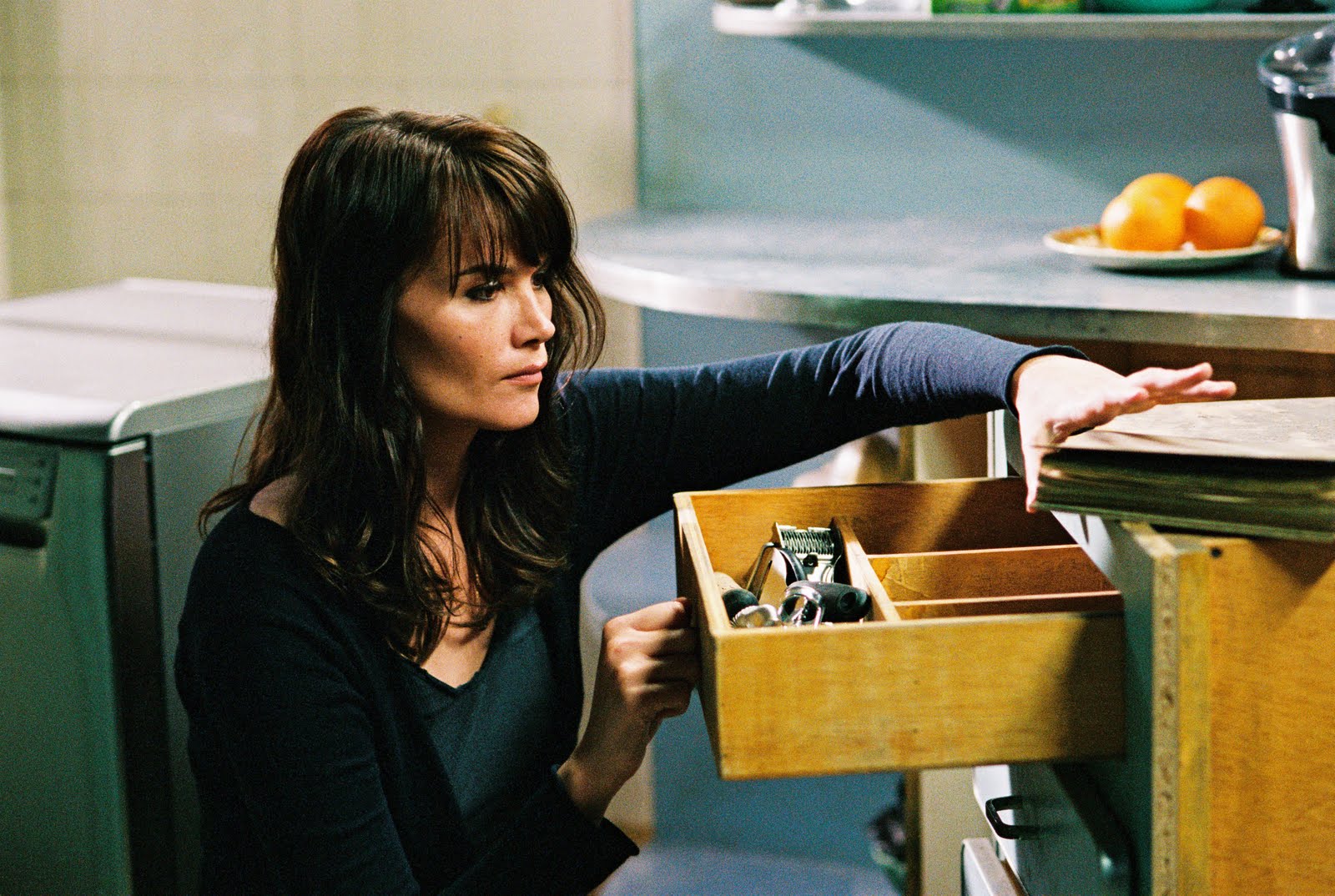
Right: Jean-Paul Belmondo as Ferdinand Griffon and Anna Karina as Marianne Renoir from the website colcoa.org

Thursday, April 22, 2010

Reel Rewind: “Mères Et Filles”


French title – “Mères Et Filles” / English title – “Hidden Diary”
This is not a direct translation of the French title into English. Although the hidden diary (title “Lost Diary” would be better) is the central element of the story, the overall driving aspect of the plot is the relationship between mothers and daughters. Therefore, I rate the actual English title used as Poor and I would use “Mothers And Daughters” as the English title.

Loss and discovery appears to be the theme of “Mères Et Filles”. Loss and discovery of life. Loss and discovery of relationship. Loss and discovery of truth. It is Louise’s (Grandmother) accidently lost and unexpectedly rediscovered diary that holds the key to the flawed relationship between Martine (Mother) and Audrey (Daughter) and Martine’s memories of Louise. The plot advances through the showing of Louise’s life as written in the diary and the impact the diary has on those who read it. When Martine finally learns her mother’s story, she realizes how mistaken she was in the thoughts she had about Louise and how this lifetime error affected her relationship with Audrey. The lost diary reveals the grandmother and returns her to her daughter. Now Martine and Audrey can reestablish a relationship built on the truth. Loss has turned into a life found.


Film Facts: Director: Julie Lopes-Curval, Writers: Julie Lopes-Curval, Sophie Hiet, Cinematographer: Philippe Guilbert, Editor: Anne Weil, Musician: Patrick Watson, Producers: Alain Benguigul, Thomas Verhaeghe, Production Companies: Sombrero Films, France 3 Cinéma
Film Type: Drama, Cast: Catherine Deneuve (Martine), Marina Hands (Audrey), Marie-Josée Cross (Louise), Michel Duchaussoy (Michel), Jean-Philippe Écoffey (Gérard), Carole Franck (Evelyne), Eléonore Hirt (Suzanne), Gérard Watkins (Gilles), Romano Orzan (Tom), Nans Laborde (Pierre), Meriem Serbah (Samira), Louison Bergman (Martine as a child), Arthur Lurcin (Gérard as a child), Manon Percept (Audrey as a child), Length: 105’, Language: French, Countries: France, Canada, Year: 2009
Film trailer
No United States release date set as of this post


Images:
Left: Front side of the ticket for “Mères Et Filles” (“Hidden Diary”)
Center: Graphic interpretation of “Mères Et Filles” created by Adrean Darce Brent

Right: Marina Hand as Audrey from the website colcoa.org

Reel Rewind: “La Petite Voleuse”


French title – “La Petite Voleuse” / English title – “The Little Thief”
This is an almost perfect translation of the French title into English. However, since the French title indicts the thief is a female and the English title doesn’t and there is no easy way to do so without having a somewhat awkward/inaccurate/inappropriate title – ‘The Little Girl Thief” (is she under thirteen?), “The Little Woman Thief” (is she a wife?), “The Little Female Thief” (best of the three suggestions) – I rate the actual English title as Good.

As the film’s source material is from an unfinished script by François Truffaut, it has been suggested that “La Petite Voleuse” is the female version of “Les Quatre Cent Coups”. Although it has been years since the last time I saw “Les Quatre Cent Coups”, I can see similarities that “La Petite Voleuse” has with that earlier film. The theme of adolescent alienation acting out with anti-social behavior is the overarching one in both films – though there are differences in the presentation of the idea, they are more alike than unlike. And although “La Petite Voleuse” has a more involved plot with a chance for Janine to change the direction of her life, she does end up incarcerated as Antoine does in “Les Quatre Cent Coups”.


Film Facts: Director: Claude Miller, Writers: François Truffaut, Claude de Givray, Adapters: Luc Béraud, Annie Miller, Claude Miller, Cinematographer: Dominique Chapuis, Editor: Albert Jurgenson, Musician: Alain Jorny, Producers: Claude Berri, Daniel Chevalier, Jean-Louis Livi, Alain Vannier, Production Companies: Orly Films, Renn Productions, Cine Cinq, Lee Films du Carrosse, Sédif Productions
Film Type: Drama/Crime/Romance, Cast: Charlotte Gainsbourg (Janine Castang), Didier Bezace (Michel Davenne), Simon de La Brosse (Raoul), Clotilde de Bayser (Séverine Longuet), Raoul Billerey (Uncle André Rouleau), Chantal Banlier (Aunt Léa), Nathalie Cardonne (Mauricette), Renée Faure (Mother Busato), Catherine Arditi (School Principal), Gilbert Bahon (Police officer), Clothilde Baudon (Bonnin), Joëlle Bruyas (Sister Marie-Odile), Denise Chiabaut (Doctor), Philippe Deplanche (Jacques Longuet), Erick Deshors (Raymond), Length: 103’, Language: French, Country: France, Year: 1988
Film scene
United States release date Friday 25 August 1989


Images:
Left: Front side of the ticket for “La Petite Voleuse” (The Little Thief)
Center: Graphic comparison of “La Petite Voleuse” and “Les Quatre Cent Coups” created by Adrean Darce Brent

Right: Simon de La Brosse as Raoul and Charlotte Gainsbourg as Janine Castang from the website colcoa.org

Wednesday, April 21, 2010

Reel Rewind: “Deux De La Vague”


French title – “Deux De La Vague” / English title – “Two In The Wave”
This is an almost perfect direct translation of the French title into English, which would be “Two Of The Wave”. I give the actual English title used a rating of Excellent.

Of the two filmmakers, I am more familiar with the works of François Truffaut than of Jean-Luc Godard. The first Truffaut film I saw was “Tirez Sur Le Pianiste” one Sunday night at college in a roomful of other foreign film loving students. The film is an early example of La Nouvelle Vague as put forth by him and Jean-Luc Godard. As I have never really known the background of the New Wave film era in France, I was happy to see the documentary “Deux De La Vague”. Over the course of the film you learn how Truffaut and Godard worked together on each other’s films and promoted their new way of filmmaking. Other contributors to the New Wave movement are mentioned including André Bazin, Claude Charbol, Éric Rohmer. Eventually Truffaut and Godard had a falling out and the French New Wave does a slow fade.


Film Facts: Director/Producer: Emmanuel Laurent, Writer: Antoine de Baecque, Cinematographers: Etienne de Grammont, Nick de Pencier, Editor: Marie-France Cuénot, Production Company: Films à Trois
Film Type: Documentary, Subject: French New Wave, François Truffaut, Jean-Luc Godard, Jean-Pierre Léaud, Length: 91’, Language: French, Country: France, Year: 2010
United States release date Wednesday 19 May 2010


Images:
Left: Front side of the ticket for “Deux De La Vague” (“Two In The Wave”)
Center: Graphic interpretation of “Deux De La Vague” created by Adrean Darce Brent

Right: Jean-Luc Godard and François Truffaut from the website colcoa.org

Reel Rewind: “Ma Vie En L’air”


French title – “Ma Vie En L’air” / English title – “Love Is In The Air”
This is not a direct translation of the French title into English, which would be “My Life In The Air”. Although the actual English title used conveys the romance aspect of the film, I prefer the French title with its irony surrounding the main character. So only a rating of Fair for the title “Love Is In The Air” and I would use “My Life In The Air” as the English title.

I first saw “Ma Vie En L’air” at the tenth year of ColCoa on Saturday 8 April 2006 and I still like it. I think it is an inspired idea to have the main character, due to the circumstances of his birth, able to fly for free for life, but is afraid of flying and is a flight simulator instructor. Love it! Basic plot – boy meets girl, boy and girl fall in love, girl goes to Australia, boy unable to overcome flying fear to visit girl, boy and girl breakup. Ten years pass and now the fun begins – boy and two girls. As the current relationship saying states, “it’s complicated” and in the film, comedic. But the question is, would you still be with the person who threw away your comic books (insert own objects)? To me, at that point, “it’s not complicated” and not comedic.


Film Facts: Director/Writer: Rémi Bezançon, Cinematographer: Antoine Monod, Editor: Sophie Reine, Musician: Sinclair, Producers: Éric Altmayer, Nicolas Altmayer, Isabella Grellat, Production Companies: Mandarin Films, M6 Films
Film Type: Comedy/Romance, Cast: Vincent Elbaz (Yann Kerbec), Marion Cotillard (Alice), Gilles Lellouche (Ludo), Elsa Kikoïne (Charlotte), Didier Bezace (Castelot), Tom Novembre (Yann’s Father), Cécile Cassel (Clémence), Philippe Nahon (Ludo’s Father), Vincent Winterhalter (Eddy), François Levantal (Passenger going to Sydney), Length: 103’, Language: French, Country: France, Year: 2005
Film trailer
Not released in the United States


Shown before the film - the short “Vinyl”
Director/Writer: Julien Hallard, Producer: Les Films Velvet, Film Type: Comedy, Length: 18’, Language: French, Year: 2009
“It is an almost ordinary day in the strangest record shop in Paris.”


Images:
Left: Front side of the ticket for “Ma Vie En L’air” (“Love Is In The Air”)
Center: Graphic interpretation of “Ma Vie En L’air” created by Adrean Darce Brent

Right: Marion Cotillard as Alice and Vincent Elbaz as Yann Kerbec from the website colcoa.org

Reel Rewind: “Une Exécution Ordinaire”


French title – “Une Exécution Ordinaire” / English title – “An Ordinary Execution”
Since I like direct translations of French film titles into English, the English title of the film is perfect.

“Une Exécution Ordinaire” is the first French film I’ve seen that takes place in Moscow. The use of the music in the opening of the film effectively establishes that the setting is not France. Unfortunately I had no idea what the image was that was been shown while the opening music played, and I still don’t. However, throughout the film I had to keep reminding myself that the story was taking place in Moscow, as there were no Russian sounds, visuals, or language cues to keep me from thinking France. That’s a definite defect in the film experience. The story is of a doctor, her husband, their dictator and the impact of tyranny on individual lives. Anna suffers tyranny at work from her supervisor who is sexually harassing her and threatens to report her unless she submits to him. Anna successfully avoids becoming the supervisor’s victim, but when Stalin learns of her healing gift there is no escape from his demands. Although Stalin tears her husband from her and has him, her mother, and her uncle put in prison to keep her under control, Anna comes through the ordeal and regains her family and a renewed life.


Film Facts: Director/Writer/Novelist: Marc Dugan, Cinematographer: Yves Angelo, Editor: Fabrice Rouaud, Producer: Jean-Louis Livi, Production Companies: F Comme Film, France 3 Cinéma, StudioCanal
Film Type: Drama/Historical, Cast: André Dussollier (Joseph Stalin), Marina Hands (Anna), Edouard Baer (Vassilli), Denis Podalydés (The Concierge), Tom Novembre (The Hospital Chief), Grégory Gadebois (Department Director), Gilles Gaston-Dreyfus (Beria), Anne Benoit (Alexandra, Anna’s mother), Gilles Ségal (Uncle Anton), Length: 105’, Language: French, Country: France, Year: 2010
Film Trailer
No United States release date set as of this post.


Images:
Left: Edouard Baer as Vassilli and Marina Hands as Anna from the website uneexecutionordinaire-lefilm.com
Center: Graphic interpretation of “Une Exécution Ordinaire” created by Adrean Darce Brent

Right: André Dussolier as Joseph Stalin and Marina Hands as Anna from the website uneexecutionordinaire-lefilm.com